In 1681, the French historian Adrien de Valois (Hadrianus Valesius, 1607–93) published an edition of Ammianus Marcellinus’ history at Paris. He presented it as a reprint of the groundbreaking edition of 1636 by his late brother Henri de Valois’s (Henricus Valesius, 1603–76), but it was in fact thoroughly updated and improved. Many of the corrections in the text that Henri had suggested in his notes were incorporated into the text; those notes appeared, along with Henri’s later thoughts and further notes by Adrien, as footnotes beneath the text rather than at the end. The books were divided into chapters, whose titles formed an epitome at the start of each book: these are the divisions still used today (for my discussion of these, see here). Another useful element of Adrien’s work was to reprint as an appendix the notes on the text written by Friedrich Lindenbrog (1573–1649) to accompany his edition (Hamburg, 1609), supplementing them with further subsequent annotations by Lindenbrog.
A few months ago, Joop van Waarden kindly pointed out to me a letter to Hadrianus Valesius from the German Classicist Johann Georg Graevius (1632–1703), who held chairs in Rhetoric and in History and Politics at the University of Utrecht. The letter, preserved in manuscript with other letters to and by French scholars in the Bibliothèque Nationale in Paris, reveals that Graevius was responsible for sourcing Lindenbrog’s later textual notes. It also offers a number of emendations on the text of Ammianus, especially book 31, and is a nice illustration of the informal networks by which the Republic of Letters operated. In what follows, I provide a text, a translation, some notes on points in the text (indicated in the text and translation by *), and a discussion of each of the emendations in turn. The original is Paris, BNF, NAL 1554, f. 73, which can be found by way of this link:
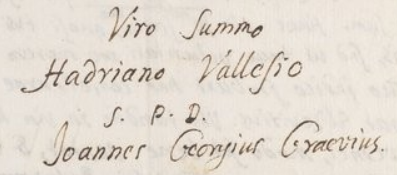
Viro summo
Hadriano Valesio
S[alutem] P[lurimam] D[icit]
Joannes Georgius Graevius.
Litteras novissimas, in quibus significavi fratris tui notas in Harpocrationem describi,* et Lindenbrogii annotationes auctiores expectari,* recte tibi redditas puto. Interea litteras habui a Langermanno, qui recepit se quamprimum invenerit, cuius fidei has sui civis lucubrationes* committere sustineat, ad nos illas missurum. Eas enim fere omnes descriptas esse. Nec dubito quin propediem simus illas uisuri, In Ammiano tuo lib. XXV p. 294 [25.4.17], videtur legendum, ut versus constet
οἱ λευκοὶ βόες Μάρκῳ τῷ Καίσαρι χαίρειν
Ἢν δὲ νικήσεις ἄμμες ἀπωλόμεθα.
Huic voto non dissimile recenset Seneca III de benef. 27.* Libro XXXI p. 435 v. 11 [31.1.3] videtur scribendum carmina quaedam nimium horrenda. P. 438 v. 25 credo sine fune distentas pro vulgato sine fine [31.2.18]. P. 443, v. 23 editur: nec victui congruis sunt adiuti [31.5.1]. Editiones veteres: nec hoc victui congruis. Forte scripsit Ammianus: nec humano victui congruis. P. 447 v. 27 vide, Vallesi doctissime, an non Ammianus scripserit: iam turmae praedatoriae discursabant compilando villas [31.5.8]. Et sic pagina sequenti videtur quoque syllaba excidisse v. 18, ubi legendum existimo in unum conspirando. Ibid. v. 36 [31.5.9] mallem, si et tibi ita videbitur: qui ad id solum intentus.* P. 445 v. 23 melius veteres editiones hac gratia, quod est, hanc ob caussam [31.5.14]. Sed nimius sum. Haec ad te \non/ scribo, quasi tu istas leves mendas non videris, sed ut tuae voluntati me morem gerere voluisse intelligas. Tuo iudico [sic, lege iudicio] stabunt hae coniecturae cadentve. Florum ad vos curat Elzevirius.* Ubi tamdiu in via haereat equidem ignoro. Sed \sat/ cito veniet, modo sat bene veniat, et tibi se probet, Vale vir illustris et me ama. Traiecti Batavorum d. XXII Maii Gregor. MDCLXXX.*
Huic voto non dissimile recenset Seneca III de benef. 27.* Libro XXXI p. 435 v. 11 [31.1.3] videtur scribendum carmina quaedam nimium horrenda. P. 438 v. 25 credo sine fune distentas pro vulgato sine fine [31.2.18]. P. 443, v. 23 editur: nec victui congruis sunt adiuti [31.5.1]. Editiones veteres: nec hoc victui congruis. Forte scripsit Ammianus: nec humano victui congruis. P. 447 v. 27 vide, Vallesi doctissime, an non Ammianus scripserit: iam turmae praedatoriae discursabant compilando villas [31.5.8]. Et sic pagina sequenti videtur quoque syllaba excidisse v. 18, ubi legendum existimo in unum conspirando. Ibid. v. 36 [31.5.9] mallem, si et tibi ita videbitur: qui ad id solum intentus.*
P. 445 v. 23 melius veteres editiones hac gratia, quod est, hanc ob caussam [31.5.14]. Sed nimius sum. Haec ad te \non/ scribo, quasi tu istas leves mendas non videris, sed ut tuae voluntati me morem gerere voluisse intelligas. Tuo iudico [sic, lege iudicio] stabunt hae coniecturae cadentve. Florum ad vos curat Elzevirius.* Ubi tamdiu in via haereat equidem ignoro. Sed \sat/ cito veniet, modo sat bene veniat, et tibi se probet, Vale vir illustris et me ama. Traiecti Batavorum d. XXII Maii Gregor. MDCLXXX.*
To the distinguished Hadrien de Valois, many greetings from Johann Georg Graevius.
I believe that my most recent letter, in which I indicated that your brother’s notes on Harpocration were being copied* and that more complete annotations by Lindenbrog were awaited,* reached you safely. In the meantime, I have had a letter from Langermann, who promised that, as soon as he found someone to whom he dared entrust these lucubrations of his fellow-townsman,* he would send them to me; he says they have practically all been copied. I have no doubt that we shall see them any day now. In your Ammianus, book 25, p. 294* [25.4.17] it seems that it should read (so the verse works):
οἱ λευκοὶ βόες Μάρκῳ τῷ Καίσαρι χαίρειν
Ἢν δὲ νικήσεις ἄμμες ἀπωλόμεθα.
Seneca recounts something not unlike this prayer in De beneficiis 3.27.* In book 31 p. 435 line 11 [31.1.3], it seems best to write carmina quaedam nimium horrenda. On p. 438 line 25 [31.2.18] I think sine fune distentas [extended without a rope] in place of the vulgate text sine fine [without end]. On p. 443, line 23 one reads: nec victui congruis sunt adiuti [31.5.1]. Old editions have: nec hoc victui congruis. Maybe Ammianus wrote: ne humano victui congruis. On p. 447 [read 444] line 27 [31.5.8] consider, most learned Vallesius [sic], whether Ammianus could not have written: iam turmae praedatoriae discursabant compilando villas. And it seems in the same way a syllable has been lost on the next page [445], line. 18, where I think it should read in unum conspirando [31.5.13]. Same page, line 36 [actually previous page, 444 = 31.5.9], I’d prefer, if it also seems right to you: qui ad id solum intentus.
On p. 445 v. 23 better are the old editions hac gratia, that is, ‘for this reason’ [31.5.14]. But that’s enough from me. I am not writing this to you as if you have not seen these minor errors, but so you understand that I wanted to support your wishes. By your judgment these conjectures will stand or fall. Elzevir will make sure you get Florus.* Where it has got stuck on the road for so long I have absolutely no idea. But it will come fast enough as long as turns up right enough, and I hope it meets with your approval. Be well, illustrious man, and keep me in your thoughts. At Utrecht in the Netherlands, on 22 May (Gregorian), 1680.*
Notes
Fratris tui notas in Harpocrationem Henricus Valesius’ notes on the grammarian Harpocration were published two years later by Jacob Gronovius, who later edited Ammianus: Henrici Valesii Notae et animadversiones ad Harpocrationem et Philippi Jacobi Maussaci notas (Leiden, 1682).
Lindenbrogii annotationes auctiores Hadrianus Valesius’ 1681 edition of Ammianus included notes by Friedrich Lindenbrog (1573-1648) in a bloc at the end, including additional notes written after his Ammianus edition of 1609: In the preface, Hadrianus writes: ‘Fridericus Lindenbrogius post editum Ammianum vixit annis plus minus triginta: quo toto temporis spatio non oblitus tanti historici, suis Observationibus plurima adjecit: quae ex urbe Hammaburgo ad me missa, corpori eius Observationum adjunxi, ac suis quaeque in locis inserui. Cunctas istas accessiones duobus asteriscis medias interposui, ut a prioribus Observationibus separarentur.’ ‘[Friedrich Lindenbrog lived around 30 years after editing Ammianus [in fact 39], and over the whole period did not forget so great a historian and added many points to his Observations. These were sent to me from the city of Hamburg and I added them to the text of his observations inserting each in their proper place. I have these supplements between double asterisks so that they can be distinguished from the earlier Observations.’]
A Langermanno… has sui civis lucubrationes The fellow townsman is Lindenbrog. Langermann is a Hamburg family. The most notable member at the time was probably Johann Lorenz Langermann, a Lutheran clergyman in Hanau (1640-1716), but perhaps we should be looking for a member of the family still resident in Hamburg.
p. 294 The page numbers are those of Henricus Valesius’ edition of 1636, which had no chapter divisions, but which did contain marginal line numbers. The chapters now used were introduced in Hadrianus’ edition of 1681 and the section numbers by Wagner and Erfurdt 1808.
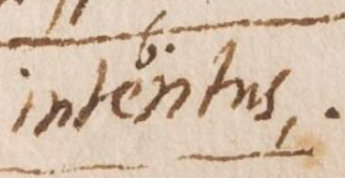
Intentus there is an abbreviation above the line that I do not understand.
Florum … Elzevirus Graevius’ edition of Florus was published in Utrecht apud Ioannem Ribbium in this same year, 1680. Probably Graevius’ friend Daniel Elzevir, the last major member of the publishing dynasty, who died later in 1680. He was not the publisher but had connections with Paris.
d. XXII Maii Gregor. The Netherlands did not adopt the Gregorian calendar until 1700, so Graevius dates according to his correspondent’s calendar.
Commentary on the individual textual suggestions
25.4.18 The Greek text transmitted in V is ΟΙ ΛΕΥΚΟΙ ΒΟΕΣ ΜΑΡΚΩ ΤΩ ΚΑΙΡΙΝ ΑΝ ΠΜ ΝΙΚΗΣΗΝ ΜΕΙΣ ΑΠΩΛΟΜΕΘΑ. Τhe elder Valesius had written οἱ λευκοὶ βόες Μάρκῳ τῷ Καίσαρι. ἂν σὺ νικήσῃς ἡμεῖς ἀπωλόμεθα. It is a satirical poem addressed by white cattle to Marcus Aurelius asking him to win victories so they can avoid falling victim to his appetite for sacrifice. The issue here is whether the transmitted Greek should be an elegiac couplet (it certainly should). Valesius 1636 had accepted Accursius’ emendation of V’s ΚΑΙ ΡΙΝ to Καίσαρι; Graevius is here clearly correct to write Καίσαρι χαίρειν (implying a sort of saut-du-même-au-même in the transmission). This correct conjecture had, however, already been made independently by Casaubon in his annotations on the Historia Augusta (1603, 155). In the second line where Valesius had written ἂν σὺ, Graevius conjectures Ἤν δὲ; the reading of V is ΑΝ ΠΜ. Either ἂν or ἢν is an acceptable substitute for ἐὰν, but neither δὲ nor σὺ (found in Gelenius) is metrical. Valesius 1636 has Gelenius’ ἡμεῖς where Graevius rightly suggests ἄμμες for the sake of the metre (V has ΜΕΙC). Again he had been anticipated by Casaubon, who had also made the light correction of indicative to subjunctive, νικήσεις το νικήσῃς. For the whole epigram, the younger Valesius simply reprinted his brother’s text with the following note:
Johannes Georgius Graevius, vir optimus atque doctissimus, mihi Traiecto Batavorum rescripsit mense Maio anno M. DC. LXXX. ut versus constet, legendum sibi videri:
Οἱ λευκοὶ βόες Μάρκῳ τῷ Καίσαρι χαίρειν
Ἂν δὲ νικήσεις ἄμμες ἀπωλόμεθα.
Addidit, huic votum non dissimile alterum commemorari a Seneca in libri III. de beneficiis capite XXVII. ἄμμες quidem Aeolice dicitur pro ἡμεῖς: sed cum in codicibus priscis omnibus Graeca haecce scripta repperiantur, ita ut a fratre meo olim sunt edita, nihil mutandum: nihil addendum puter, ne temeritatis accuser, si a codicibus consentientibus sine causa recessero, quorum auctoritate plurimi faciendam nemo nescit. Versum quidem stare nihil necesse est. Ingeniosa tamen est amici nostri coniectura: cui libenter acquiescerem, ni conspiratio codicum obstaret.’
[Johann Georg Graevius wrote to me from Utrecht in the Netherlands in May 1680, that he thought to work as verse it should read: … He added that a second prayer not unlike this is mentioned by Seneca in Ben. 3.27. Now, ἄμμες is the Aeolic for ἡμεῖς, but since in the old manuscripts the Greek is to found just as my brother edited it long ago, I should think that nothing should be changed, nothing added, lest I be accused of rashness if I abandon without cause the unanimous reading of the manuscripts – whose authority everybody knows should be held in the highest regard, as I hardly need say. Still, my friend’s conjecture is ingenious, and I would willingly agree to it were it not that the unanimity of the manuscripts stood in the way.’].
Interestingly, a similar but even more developed solution to the passage reached Hadrianus soon afterwards, in the notes of Lindenbrog sent from Hamburg (which he printed in an appendix). Lindenbrog identified and solved metrical problems in both lines – though both his solutions had already been reached by Casaubon. In the first line they both replaced οἱ λευκοὶ βόες, with the anomalous short fourth syllable, with with οἱ βόες οἱ λευκοὶ; in the second they added an additional short syllable to make: ἂν δὲ σὺ νικήσῃς. Though this scans modern editors rightly print Haupt’s ἂν πάλι νικήσῃς (if you win again), which is much closer to the reading of V (ΠΜ). But in the first line, we might wonder whether the emendation has gone too far. I have no doubt that it represents the original form of the epigram from the second century. But what if the transposition was an overcorrection and Ammianus incorporated a version with a relatively minor metrical error? Ammianus would mainly have been transmitted by copyists ignorant of Greek and unlikely to swap the words. That said, most editors will probably have the same reaction as Joop van Waarden did when I suggested this, to doubt that an educated Greek like Ammianus would make such an error. Let me close by adding my own translation of the couplet:
Marcus the Caesar we white oxen greet –
But please don’t win again, or we’re dead meat.
To sum up: Graevius is right on most points, though he had been anticipated by Casaubon and Lindenbrog; Hadrianus quotes Graevius but disagrees. We could consider adding the name of Graevius to apparatuses for Καίσαρι χαίρειν, which he seems to have reached independently. I may well print the unmetrical οἱ λευκοὶ βόες in my edition.
31.1.3 Ammianus speaks of ghosts howling by night, in V, carmina quaedam nimiarum horrenda, but nimiarum had been replaced by a renaissance corrector of V, followed by Accursius and the elder Valesius, with nimirum, ‘certain songs, indisputably frightening’. This suggestion, nimium,‘certain exceptionally horrifying songs’, is an improvement, and Hadrianus printed it without comment or attribution. Modern editors rightly print Gronovius senior’s emendation neniarum ‘certain grim dirge-like songs’; nimium gives a bad clausula, though neither Hadrianus nor Graevius is likely to have known that: prose rhythm was not generally understood at the time.
31.2.18 Nobody has ever followed up on the suggestion of sine fune distentas, and Hadrianus ignores it.
31.5.1 V reads ne hoc uictui congruis sunt adiuti, followed by Accursius and some sixteenth-century editions as ne hoc; Gelenius’ second edition deleted hoc, and Lindenbrog emended to nec, ‘and they were not aided with any provisions’(I am not aware of any old edition that reads nec hoc).
31.5.8 The transmitted text is iam turmae praedatoriae concursabant pilando uillas et incendendo (‘now raiding bands dashed about, plundering and burning villas’); Graevius proposes a swap of prefixes with discursabant, compilando. These compound forms are commoner, but the transmitted forms accord with Ammianus’ usage. Hadrianus Valesius preserves concursabant, but emends (unnecessarily) to praedando.
31.5.13 Unum spirando uesania gentium dissonarum V (‘breathing as one, the madness of discordant nations…’). Henri de Valois’ edition had printed in unum spirando, and Graevius changed this to in unum conspirando. His instincts were correct, as conspiro is intransitive and Ammianus uses it with in unum several times (17.10.2, 26.5.11). But since spirando is transitive and since Ammianus elsewhere uses unum spiro (24.3.4, 27.10.9, 29.5.28) the transmitted text is fine, and indeed it is restored by Hadrianus Valesius.
31.5.9 quia ad id solum inuentus V was corrected to qui… by Accursius, but a commander ‘who, being found for this alone, rushed to escape while others were still fighting’ is hard to defend; intentus is printed by modern editions, attributed to Bentley and Gardthausen and approved by Petschenig; Graevius anticipated both the former, but he was ignored by Hadrianus, who printed inuentus. Graevius’ name should, therefore, enter the apparatus.
31.5.15 Hac gratia is the generally accepted reading, printed by Hadrianus, and Valesius 1636’s haec gratia is presumably just a typo.
The overall results might disappoint: Graevius’s correct emendations had, with one exception, already been made by others; others, while clever, were based on false information. Still, it is clear that he was the contact to whom we owe the publication of Lindenbrog’s later emendations, and it is interesting to see his enthusiasm, for the most part focused in a fairly narrow part of the text, for supporting Adrien’s reworking of his brother’s great edition.